
Should I Use a Lump Sum Bonus to Pay Down My Mortgage?
If you get a bonus, a tax refund, an inheritance, or a big commission cheque and you're wondering whether to throw it at your mortgage — the answer is: it depends on your situation. But the math on what even a small lump sum does to a mortgage might surprise you.
The First Question I Always Ask
Before I even talk about the mortgage, I ask one thing: do you have any other debt outside of it? Credit cards, a line of credit, a car loan? If yes, those need to go first. High-interest debt costs you more than your mortgage does, every single day. Clearing that before putting money on the mortgage is almost always the smarter move.
If the answer is no and the mortgage is your only debt, then we can have a real conversation about what to do with that money.
It's Still a Personal Decision
From there, the conversation looks a lot like the mortgage versus investing question. What stage of life are you in? How far away is retirement? What's your risk tolerance? What's going to give you the most peace of mind?
I can show you exactly what a lump sum payment does to your mortgage. I can't tell you what it would do if you invested it instead — that's a financial advisor's job, not mine. But I can show you your mortgage side of the equation in real numbers, and those numbers are often enough to help someone make up their mind.
But First - Know Your Prepayment Rules
Here's something a lot of people don't realize. You can't just throw any amount of money at your mortgage whenever you want. Most Canadian mortgages come with prepayment privileges, and if you go over them, you'll pay a penalty.
Every bank and lender is a little different, but in general you're allowed to prepay somewhere between 10% and 20% of your original mortgage balance per year without any penalties. That extra payment goes directly to your principal (not interest), which is where it does the most good.
Before you make any lump sum payment, check with your lender to find out exactly how much you can put down, how often, and when. It's worth a quick phone call to make sure you're not accidentally triggering a penalty.
What a Lump Sum Actually Does to Your Mortgage
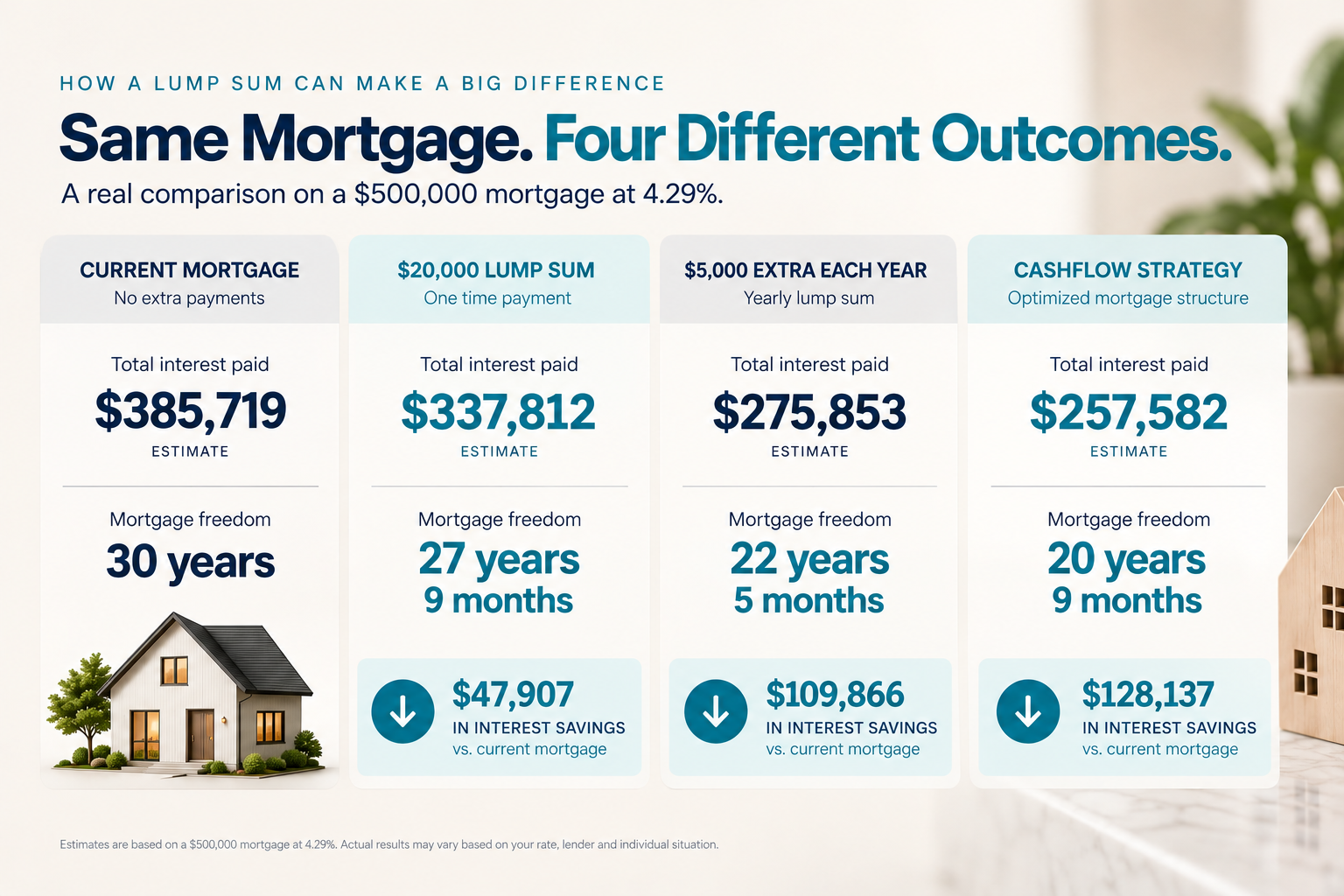
This is where it gets interesting. Here's a real comparison on a $500,000 mortgage with a monthly payment of $2,460 over 30 years.
With no extra payments at all, you'd pay $385,719 in interest over the life of the mortgage. Your total cost is $885,719.
Now watch what happens when you make one lump sum payment of $20,000. Your mortgage drops to 27 years and 9 months, and you save $47,907 in interest. One payment. Done.
And if instead you put an extra $5,000 toward your mortgage every year, your amortization drops all the way to 22 years and 5 months. That's 7.5 years off your mortgage. And you save nearly $110,000 in interest over the life of the loan.
That's the part that makes people's jaws drop a little. A few thousand dollars a year, applied consistently, can save you six figures. If you want to dig into more ways to pay your mortgage off faster, there are some great strategies that work even without a big windfall.
Do You Have to Put It All on the Mortgage?
Absolutely not. And honestly, please don't feel guilty if you don't.
You have to live your life. If you want to spend your bonus on a trip, a renovation, or something that makes you happy, go for it. No judgment. The mortgage will still be there, and even a partial lump sum payment does more than nothing.
If you want a middle ground, split it. Put some toward the mortgage and use the rest however you like. There's no rule that says it has to be all or nothing.
The goal isn't to make yourself miserable paying off a mortgage. The goal is to get ahead without giving up the life you're working for.
Some people also find that when they get serious about turning their 30-year mortgage into a shorter-term plan, combining lump sum payments with a smarter payment structure can make a huge difference faster than they expected.
Want to See What Your Numbers Look Like?
If you've got a bonus coming and you're curious what it could actually do to your mortgage specifically, let's look at it together. A mortgage check-up is a great starting point — we can run your numbers and figure out the smartest way to use whatever extra money you have coming in.
You might be closer to mortgage freedom than you think.
If you got a $10,000 bonus tomorrow, what would you do with it (and does that answer tell you something about your priorities)?
Key Takeaways
Before putting a bonus on your mortgage, pay off any high-interest debt like credit cards or loans first.
Most Canadian mortgages allow you to prepay 10% to 20% of your original mortgage balance each year without penalties, check your specific lender's rules before making a lump sum payment.
On a $500,000 mortgage, a single $20,000 lump sum saves nearly $48,000 in interest and cuts over 2 years off the amortization.
Adding just $5,000 extra per year saves nearly $110,000 in interest and cuts 7.5 years off the mortgage.
You don't have to put it all on the mortgage. Splitting a bonus between the mortgage and something fun is a perfectly smart move.
The goal is to get ahead without being miserable, enjoy your life and make progress at the same time.