
Is Manulife One Right for Me?
Manulife One can be a great fit if you have steady income, money left over each month, and a goal of getting rid of your mortgage sooner. But if having access to more credit usually means spending more, I’d probably point you in another direction.
I recently reviewed a mortgage that was on track to take another 40 years to pay off. A few weeks before that, I spoke with someone whose amortization was showing 60 years.
Yikes. Most people would like to retire before their mortgage does.
Those conversations are a good reminder of why I look beyond the rate and monthly payment. You also need to know where those payments are taking you.
A real example: when the payment stays the same, but the finish line moves
The homeowner in this review had approximately $723,000 left on their mortgage and was coming up for renewal in a few months.
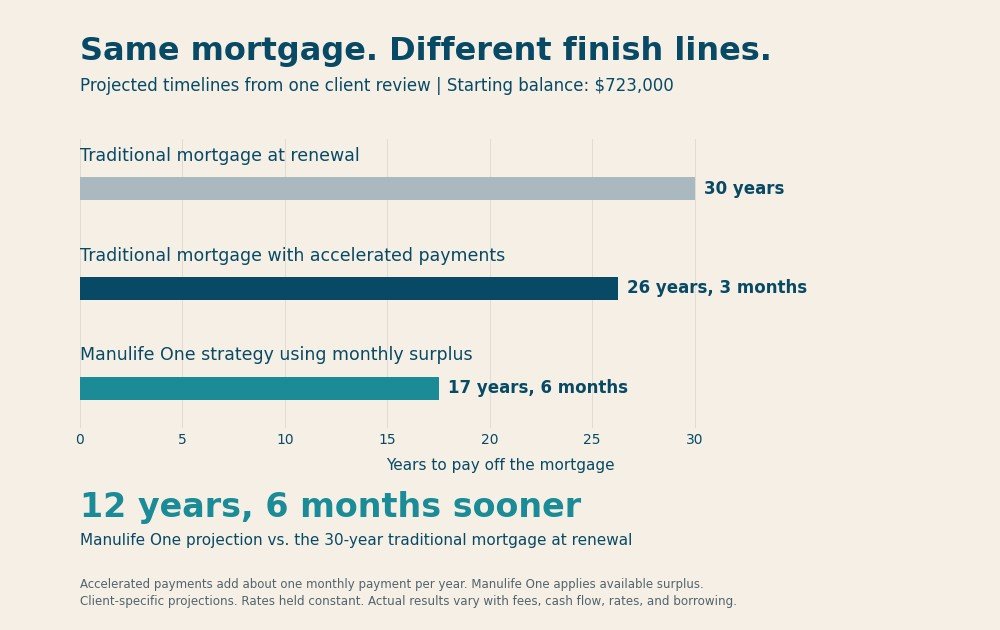
They had a variable-rate mortgage, but their payment had stayed the same as interest rates rose. More of that payment went toward interest, unpaid interest accumulated, and their repayment timeline stretched out. Based on their balance, payment, and rate, they were now looking at approximately 40 years.
Their payment hadn’t been getting their attention. The repayment timeline certainly got mine.
At renewal, they needed to bring this mortgage back to a 30-year repayment schedule, which meant a higher payment. That’s the renewal payment I used for our comparison.
What could their renewal look like with a different plan?
For this comparison, I looked at three options: regular mortgage payments over 30 years, accelerated payments, and using their available cash flow through a Manulife One strategy.
Here’s what the projections showed:
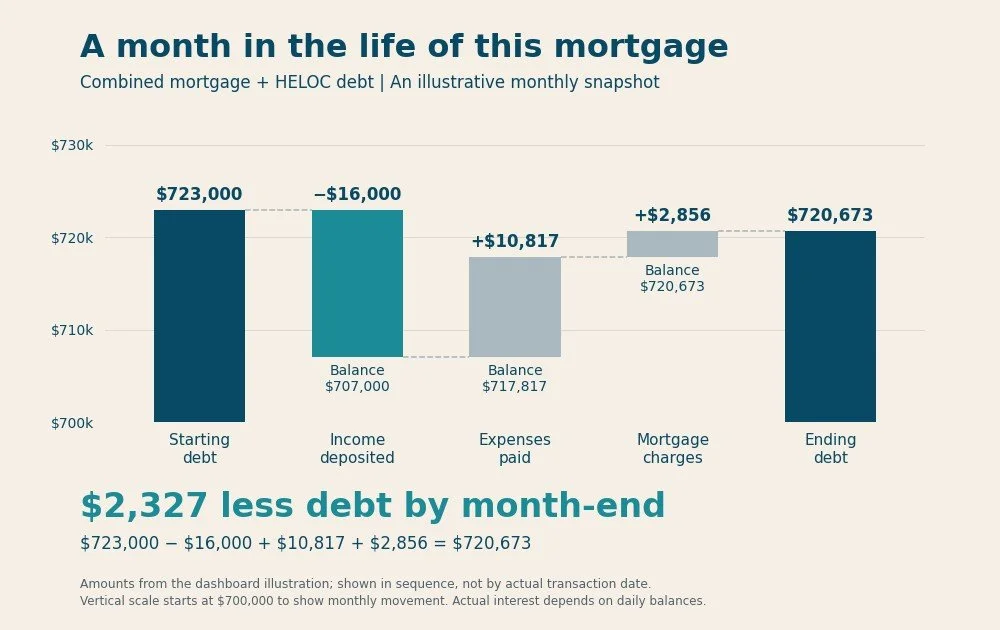
These are combined mortgage and HELOC figures, not the balance in the main account alone. The steps show the monthly arithmetic rather than actual transaction dates; the timing of deposits and withdrawals affects daily interest.
What went into the comparison?
The household brought home $16,000 a month, with $14,000 in expenses and an initial $2,000 monthly surplus. After allowing for the higher scheduled payment under the proposed structure, approximately $1,441 a month remained to work against the main-account borrowing balance.
The model used a 3.37% traditional mortgage rate, 4.79% on the Manulife One mortgage portion, and 4.95% on the HELOC portion. It held rates constant for the projections and included an account-fee waiver for the first three years. These are the rates and fee assumptions used in this review, not a current offer or a forecast of future rates.
This compares regular traditional mortgage payments with a strategy that also applies available surplus. The faster payoff reflects those extra contributions as well as the account structure and how it is used. It doesn’t establish the same advantage over a traditional mortgage receiving identical contributions.
These are projected results, not outcomes the client has already achieved. Changes in rates, spending, fees, or future borrowing will affect the actual outcome.
The other part of this decision is what happens if you need access to money along the way. Because paying down debt is a great goal, but so is being able to handle an unexpected bill.
So how does Manulife One actually work?
With a traditional setup, your pay usually lands in a chequing account, your mortgage payment comes out, and any leftover money waits for instructions.
Sometimes those instructions are “make an extra mortgage payment.” Sometimes they’re “apparently we need a new dishwasher.”
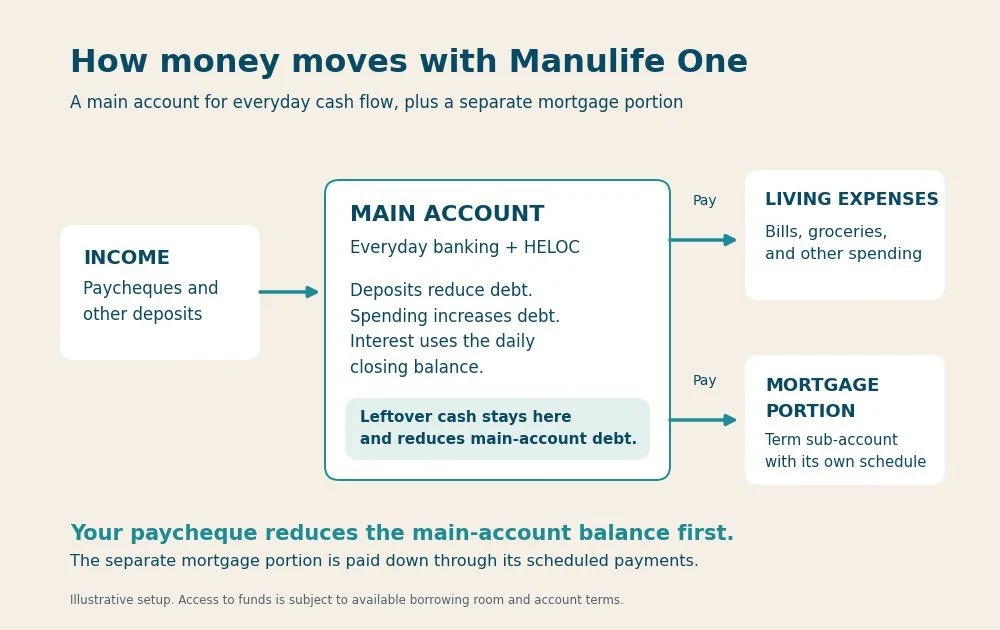
Manulife One brings your everyday banking and borrowing together. Your income goes into the main account and reduces the amount owing there immediately. As you pay expenses, the balance rises again.
Interest on that main account is calculated on its daily closing balance. While your income is sitting against the debt, it reduces the balance being charged interest.
You can also have separate mortgage portions called term sub-accounts, with their own rates and repayment schedules. Your income reduces the main account balance; it doesn’t automatically pay down those separate portions.
The daily interest benefit helps, but consistent surplus is what keeps the debt moving down over time. The account can’t do that if everything coming in gets spent again.
Who is a good fit for Manulife One?
You have money left over most months
For a mortgage payoff strategy, I generally look for at least $500 a month left over after the mortgage, other debt payments, and living expenses. That’s my suitability guideline, not a Manulife approval rule.
A good income is helpful. What matters just as much is how much you keep.
And we need real expense numbers. Car repairs, insurance, holidays, and Christmas still count, even when they don’t appear on this month’s bank statement.
You want your mortgage gone before retirement
A lot of people I talk to feel they should be further ahead. They’ve been working, making payments, and doing what they thought they were supposed to do. Yet the mortgage still looks very comfortable hanging around.
If paying off your mortgage before retirement is your goal and you have a consistent surplus, this is worth exploring. It can help keep that money working against your debt through your everyday banking.
You want access to your equity
Some homeowners also want access to an approved borrowing facility without arranging a new refinance every time they need funds.
As retirement approaches, I may discuss whether setting that up while you’re still working makes sense. We’d consider your future income and how you would repay anything you borrow.
Access is subject to the approved limit and account terms. It’s useful flexibility, but it’s still debt when you use it.
Manulife lists at least 20% equity for a transfer or refinance, or a 20% down payment for a purchase, as a starting requirement. The full application still needs lender approval.
When would I advise against Manulife One?
If available credit tends to become additional spending, I don’t want to make your home equity easier to reach.
I’d be cautious if you regularly spend everything you earn, carry credit card balances that don’t come down, or have refinanced repeatedly to clear debts only to build them back up again.
Having debt doesn’t automatically make you a poor fit. I want to understand what caused it and whether that pattern has changed.
Refinancing your mortgage to pay off debt can improve cash flow. But if the spending problem continues, you’ve moved the debt without solving the reason it keeps coming back.
Sometimes a traditional mortgage with more defined payments and less accessible borrowing is the better fit. That’s a perfectly good outcome from a review, too.
Couldn’t I just pay extra on my current mortgage?
Absolutely. The accelerated option in the comparison above is one example. Applying extra money to principal can take years off a traditional mortgage, too. We should compare that option using the same total cash available for repayment, rather than assuming the account structure deserves all the credit.
If you have a one-time windfall rather than a monthly surplus, I also walk through the decision about using a lump sum bonus to pay down your mortgage.
Before making extra payments, check your lender’s prepayment privileges. Going over the permitted amount can trigger a penalty.
But there’s another question I think deserves just as much attention: how comfortable are you putting that money somewhere you can’t easily get it back?
With a standard mortgage that doesn’t have a linked borrowing facility, extra payments reduce your balance and become equity in your home. You generally can’t simply withdraw them later. You may need to arrange a refinance or another secured loan, qualify again, or access that equity when you sell.
That’s why someone can have money left over and still hesitate to put all of it on the mortgage.
They’re thinking, “What if the car needs repairs? What if my income changes? What if the furnace decides January is a good time to retire?”
Those are reasonable questions. Wanting a safety net doesn’t mean you aren’t serious about paying down debt.
Paying down debt without giving up all your flexibility
With Manulife One, money left against your main-account borrowing balance reduces the debt and the interest charged on it. If you need funds later, you can borrow within your available borrowing room, subject to the account terms.
That can make it easier to leave surplus money working against the debt instead of holding all of it in a separate account just in case.
For the right client, that combination is a big part of the appeal: making progress while keeping access to an approved borrowing facility.
There are two details I want you to understand. Withdrawing funds increases your debt again and can push the payoff date back. And payments toward some term sub-accounts don’t create additional borrowing room, so the setup matters.
Other banks offer readvanceable mortgages and linked lines of credit, too. But having access to equity isn’t the same as having your everyday income automatically reduce your borrowing balance. A readvanceable feature alone doesn’t create the same all-in-one flow of money.
In my experience, Manulife One has been the easiest structure to work with for helping suitable clients pay off debt faster because so much happens automatically once it’s set up properly. Your income goes in, your expenses go out, and the money you don’t spend stays against your main-account debt. You don’t have to keep deciding whether to move the leftover money over as an extra payment. It’s already there, doing its job.
That simplicity is a big reason I like it. You still need to manage your spending and review your progress, but you aren’t adding another monthly task to an already busy life. My calculator and Mortgage Momentum Plan dashboard help us see whether that approach fits your numbers and your goals.
What’s the catch?
You need to be willing to change how you run your banking, and you need to avoid borrowing back all your progress.
If you’ve done things the same way for 20 or 30 years, the change can feel unfamiliar. That’s understandable. Moving income deposits and bill payments is one thing; getting comfortable seeing your banking and borrowing together can take a little longer.
There are costs to review, too: account fees, potential setup and legal costs, and any penalty for leaving your existing mortgage early. Term sub-accounts can have prepayment restrictions, and the main account’s variable rate can change.
That’s why the setup matters. Putting everything in one big line of credit may be the simplest explanation, but it isn’t necessarily the best arrangement for you. Lender rules may also require some borrowing in a term sub-account.
When I structure your Manulife One mortgage, I review your income, expenses, other debts, and goals to determine the split and how often we may need to rebalance it. Then we have annual check-ins to see whether you’re on track.
Your life won’t stand still for the next 15 or 20 years. Your mortgage plan needs some attention along the way.
Why haven’t I heard about it before?
If you’ve always dealt with your existing bank, you may never have been introduced to Manulife One or this way of managing your money.
Different lenders offer different structures, and advisors have different levels of experience with them. Something can be unfamiliar to you simply because it hasn’t been part of the conversations you’ve had.
That’s one reason I now run a monthly live webinar: so people can see how it works, ask questions, and decide whether they can picture using it themselves.
You don’t need to be convinced in five minutes. Bring your skepticism. Just bring your numbers, too.
Common questions about Manulife One
Do I have to move my everyday banking to Manulife One?
The strategy I model relies on income flowing into the Manulife One main account and everyday expenses being paid from it. You can keep other accounts, but money sitting elsewhere isn’t reducing the borrowing balance in your Manulife One account.
Can I still use a credit card for everyday expenses?
Yes. Many of my clients put eligible everyday expenses on a credit card, then pay the full statement balance from their Manulife One main account by the due date. This lets the money stay against the main-account borrowing balance longer, reducing the amount subject to daily interest while it remains there.
The key is paying the full statement balance on time and keeping the card’s purchase grace period intact. Carrying an interest-bearing card balance can outweigh the benefit, and cash advances don’t have the same interest-free grace period.
Money earmarked for the card bill is still spoken for. The idea is to change the timing of payment, not the amount you spend.
Is Manulife One just a HELOC?
It includes revolving borrowing, but it also combines everyday banking with the option of separate mortgage portions called term sub-accounts. Those portions can have their own rates and repayment schedules, so the setup can be quite different from putting the entire balance on a line of credit.
What happens if I have an expensive month with no money left over?
One expensive month doesn’t mean the whole plan has failed, but it can slow your progress or increase your borrowing. Required payments and account limits still apply, so we need room for irregular expenses rather than a budget that only works when nothing goes wrong.
Can I switch to Manulife One before my mortgage renews?
Potentially, if you qualify, but we first need to weigh any mortgage-breaking penalty and setup costs against the projected benefit. Sometimes switching earlier makes sense; sometimes waiting for renewal is the better move.
Start with the calculator, not a commitment
If you’re thinking, “This might suit us,” the next step is my mortgage savings calculator.
It gives you an initial mortgage-to-mortgage comparison using your own numbers, so you can see whether the potential time or interest savings make a closer look worthwhile.
A full review comes after that. Other debts can change the picture considerably, especially if restructuring their payments frees up cash flow. We’d also consider the cost of repaying those debts over a longer period and securing them against your home.
I’m not sure if Manulife One is right for you yet. But we can start by finding out whether there’s an opportunity worth exploring.
Key takeaways
Manulife One may suit homeowners with steady income, consistent surplus, and a repayment or equity-access goal.
I generally look for at least $500 left over each month when assessing a mortgage payoff strategy.
If easier access to credit leads to more spending, another structure may fit you better.
Extra payments can shorten a traditional mortgage, but compare the projected payoff, total costs, and access to funds as well.
Manulife One can provide access within your available borrowing room. Using it increases debt again, and not every principal payment creates more room.
The setup and ongoing follow-up matter. Getting approved is only the beginning.
Start with the calculator to see whether a full review is worth your time.
About Amanda Greville
Amanda Greville is a Mortgage Agent Level 2 with BRX Mortgage, License #13463. Based in Hamilton, she works virtually with homeowners across Ontario on mortgage renewals, refinancing, and cash-flow strategies. Her Mortgage Momentum Plan uses a custom calculator and dashboard to help clients understand their options and plan a route toward becoming mortgage-free.